
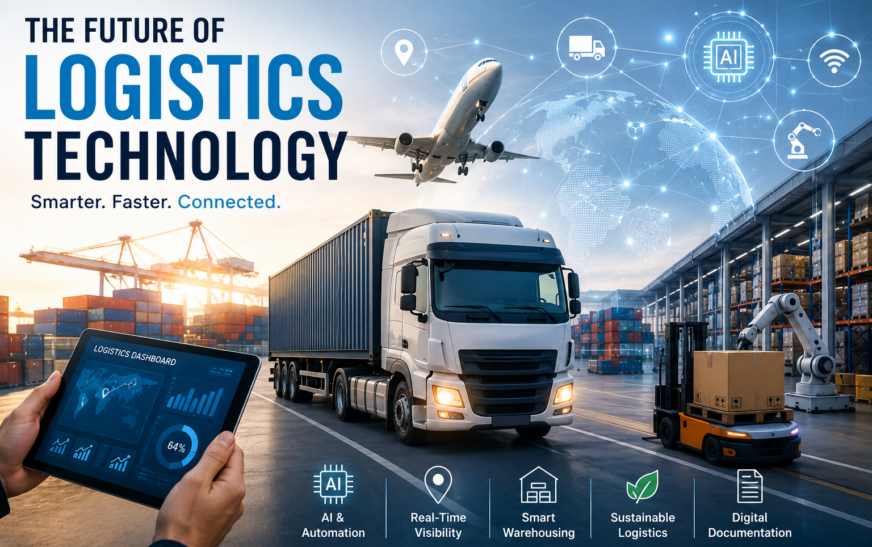
Technology is changing the logistics industry faster than ever. Activities that previously depended on phone calls, paperwork, spreadsheets and manual tracking are increasingly being handled through connected digital platforms.
Artificial intelligence is helping businesses forecast demand and plan routes. Robots are moving products inside warehouses. Internet-connected sensors are providing real-time shipment information. Digital freight documents are reducing paperwork, while autonomous vehicles are beginning to move beyond experimental testing.
These changes are not limited to large international companies. Freight brokers, dispatchers, fleet managers, warehouse operators, transport companies and small logistics businesses are also using technology to improve visibility, reduce delays and communicate more effectively.
However, not every new technology is equally mature. Some tools are already widely used, while others are still being introduced in selected markets. Understanding the difference is important for businesses, students and professionals preparing for the future of logistics.
Here are the most important logistics technology trends shaping the industry in 2026.
1. Artificial Intelligence Is Becoming Part of Daily Logistics Operations
Artificial intelligence is no longer limited to research projects or advanced technology companies. It is increasingly being added to transportation management systems, warehouse platforms, customer-service tools and supply-chain software.
AI can analyse large volumes of information much faster than a person working manually. It can examine delivery history, weather conditions, traffic, order patterns, vehicle availability and customer demand to recommend better operational decisions.
Logistics companies are using AI for:
- Demand forecasting
- Route planning
- Delivery-time prediction
- Inventory management
- Freight-price analysis
- Document processing
- Customer communication
- Equipment maintenance
- Risk identification
For example, an AI-supported route-planning system can compare several possible routes and consider distance, traffic, tolls, fuel usage and delivery deadlines. It can then recommend a route that meets the company’s priorities.
AI does not remove the need for logistics professionals. A dispatcher or fleet manager still needs to understand drivers, customers, freight requirements, compliance and unexpected situations. AI provides faster information, but people remain responsible for judgement, communication and accountability.
2. Generative and Agentic AI Are Moving Beyond Simple Chatbots
The first generation of logistics chatbots mainly answered basic questions. Newer generative AI systems can assist with more complex work, including summarising documents, preparing customer updates, reviewing operational information and creating reports.
A freight company may use generative AI to turn shipment data into a clear status update. A dispatcher may use it to summarise communication history before contacting a driver. A warehouse manager may use it to prepare an incident report from multiple internal notes.
The next development is agentic AI. An AI agent is designed to complete a sequence of tasks toward a defined goal rather than only responding to a single question.
A future logistics AI agent could:
- Detect that a shipment may be delayed.
- Check alternative routes.
- Review available vehicles or carriers.
- Estimate the cost of each option.
- Prepare a recommended action.
- Notify the appropriate team member.
Most logistics organisations are not yet operating fully autonomous AI-controlled supply chains. Data quality, security, legal responsibility and human approval remain important limitations. Nevertheless, agentic AI is becoming an important area of logistics innovation.
3. Predictive Analytics Is Helping Companies Act Before Problems Occur
Traditional logistics management often reacts after something goes wrong. Predictive analytics attempts to identify the risk before the disruption becomes serious.
The technology uses historical and real-time data to estimate what may happen next. It can identify patterns that suggest a vehicle breakdown, inventory shortage, port delay, delivery failure or sudden change in demand.
Predictive analytics can help a company answer questions such as:
- Which shipment is most likely to arrive late?
- Which vehicle may require maintenance soon?
- Which product could run out of stock?
- Where might demand increase next month?
- Which route experiences repeated delays?
- When should additional warehouse staff be scheduled?
The quality of the prediction depends on the quality of the data. Incomplete, outdated or inaccurate records can result in poor recommendations. Companies therefore need organised data systems before they can receive the full benefit of advanced analytics.
4. Smart Warehouses Are Using Robots and Computer Vision
Warehouse automation is one of the most visible changes in modern logistics.
Many warehouses now use autonomous mobile robots to move goods between storage, picking and packing areas. Unlike older machines that followed fixed tracks, modern mobile robots can use sensors and maps to move through changing environments.
They can slow down when an employee crosses their path, select another route when an aisle is blocked and receive updated tasks from warehouse management software.
Robots are commonly used for:
- Moving shelves or containers
- Transporting picked products
- Sorting packages
- Pallet movement
- Inventory scanning
- Repetitive material handling
Computer vision is also becoming more important. It allows software to interpret images or video captured by cameras.
In a logistics facility, computer vision can help detect damaged packages, read labels, count inventory, check loading activity and identify possible safety concerns.
The purpose of warehouse robotics is not simply to replace people. The more practical goal is to reduce repetitive movement, increase consistency and allow employees to focus on work that requires judgement, problem-solving and supervision.
5. IoT Sensors Are Improving Real-Time Shipment Visibility
The Internet of Things, commonly called IoT, connects physical equipment to digital systems through sensors and communication networks.
A connected truck, trailer, shipping container or package can provide information about its location and condition. Depending on the equipment, sensors may track:
- GPS location
- Temperature
- Humidity
- Door status
- Vehicle speed
- Fuel usage
- Engine condition
- Sudden movement
- Unauthorised access
This is especially important for pharmaceutical products, food, chemicals and other temperature-sensitive cargo. A company can receive an alert when the temperature moves outside an approved range instead of discovering the problem after delivery.
Real-time visibility also improves customer communication. Instead of repeatedly calling drivers or transport partners, authorised users can view shipment progress through a tracking platform.
However, collecting data is only the first step. Businesses need systems that convert sensor information into useful alerts and decisions. Too many unnecessary notifications can make the system difficult to manage.
6. Digital Twins Are Creating Virtual Models of Supply Chains
A digital twin is a virtual representation of a physical system. In logistics, it may represent a warehouse, fleet, port, transport network or an entire supply chain.
The digital model receives information from actual operations and allows managers to test possible decisions without immediately changing the real system.
A company could use a digital twin to examine questions such as:
- What happens if a major port becomes unavailable?
- How will a warehouse perform during peak season?
- What happens if product demand rises suddenly?
- Where should inventory be stored?
- How will a new delivery hub affect transportation time?
- Which alternative route provides the best result?
Digital twins can be particularly helpful during disruptions. Managers can compare possible responses and understand how one decision may affect inventory, cost, delivery time and customer service across the wider network.
Building an accurate digital twin requires reliable data from several departments and partners. For this reason, digital twins are more practical for companies that already have connected systems and organised information.
7. Electronic Freight Documents Are Replacing Paper Processes
Logistics has traditionally depended on large amounts of paperwork, including bills of lading, booking confirmations, delivery documents, invoices and customs records.
Paper-based processes can create delays when information must be entered repeatedly into different systems. Documents may also be lost, submitted incorrectly or delivered to the wrong party.
The shipping industry is moving toward electronic bills of lading and standardised digital documents. In May 2025, the Digital Container Shipping Association announced the successful completion of a standards-based interoperable electronic Bill of Lading transaction.
Interoperability is important because different companies may use different technology platforms. A digital document provides greater value when it can move securely between carriers, shippers, banks and technology providers without forcing every participant to use the same system.
Electronic documents can help:
- Reduce repetitive data entry
- Improve document visibility
- Lower the risk of physical loss
- Speed up approvals
- Support remote processing
- Improve information accuracy
- Reduce dependence on paper
Adoption is increasing, but the transition will take time. Technology standards, legal recognition, cybersecurity and cooperation between organisations all influence how quickly digital documents become normal across global trade.
8. Air Cargo Is Moving Toward Shared Digital Shipment Records
Air cargo is also becoming more data-driven.
IATA’s ONE Record initiative creates a standard method for sharing cargo information among airlines, freight forwarders, handlers, shippers and other authorised participants. Instead of each company maintaining disconnected versions of shipment information, ONE Record supports a shared digital view.
From January 2026, IATA positioned ONE Record as the preferred approach for cargo data exchange.
This development can help reduce fragmented information and provide stakeholders with more consistent shipment data. It may also support future automation because digital systems can access structured information more easily than details contained in separate emails, documents and spreadsheets.
For logistics professionals, this means data management and digital communication are becoming increasingly important parts of air-freight operations.
9. Autonomous Trucks Are Entering Commercial Freight Operations
Self-driving trucks have been discussed for years, but recent developments show that autonomous freight is beginning to move from controlled trials into selected commercial operations.
In May 2025, Aurora announced the beginning of commercial driverless trucking between Dallas and Houston in Texas. The development is important because the trucks were used for freight operations without a driver behind the wheel on the selected route.
This does not mean that all trucks will become driverless soon. Autonomous freight currently depends on specific operating areas, detailed mapping, suitable roads, regulatory conditions and extensive safety systems.
The most likely early model is limited autonomous operation on predictable highway routes, supported by people at terminals and control centres.
Human workers will still be needed for:
- Loading and unloading
- Vehicle inspection
- Customer communication
- Local delivery
- Exception management
- Maintenance
- Safety supervision
- Regulatory compliance
Autonomous trucking could eventually change how long-distance freight capacity is managed, but widespread adoption will depend on safety, regulation, infrastructure, cost and public trust.
10. Drones and Alternative Delivery Systems Are Expanding
Drones are being tested and used for selected delivery situations, particularly where road access is limited or rapid delivery is valuable.
Potential applications include:
- Medical-supply delivery
- Remote-area delivery
- Emergency transportation
- Small parcel delivery
- Warehouse inventory checks
- Yard and facility inspection
Drones are unlikely to replace conventional delivery vehicles for most shipments. Their carrying capacity, flight range, weather limitations and regulatory requirements restrict where they are practical.
Instead, drones are likely to become one part of a larger delivery network. A distribution centre or vehicle may act as a launch point while the drone handles a limited final segment.
11. Sustainable Logistics Technology Is Becoming an Operational Priority
Environmental performance is increasingly connected with logistics technology.
Companies are using electric delivery vehicles, route-optimisation software, renewable energy, sustainable aviation fuel, improved packaging and carbon-measurement platforms to reduce emissions.
Technology can support sustainability by helping companies:
- Reduce empty vehicle movement
- Select more efficient routes
- Improve vehicle utilisation
- Track fuel consumption
- Measure shipment emissions
- Reduce warehouse energy use
- Plan electric-vehicle charging
- Identify unnecessary packaging
Sustainable technology is not only about purchasing electric vehicles. An inefficiently planned electric fleet may still create operational problems. Businesses must consider charging infrastructure, route length, vehicle capacity, electricity availability and delivery schedules.
Leading logistics companies are also investing in sustainable aviation fuel and solar-powered facilities. These developments show that green logistics is becoming part of long-term operational planning rather than remaining a separate marketing activity.
12. India’s Digital Logistics Ecosystem Is Growing Through ULIP
India is developing an increasingly connected logistics ecosystem through the Unified Logistics Interface Platform, or ULIP.
ULIP allows authorised logistics applications to access information available across different government systems through secure digital connections. It is intended to improve coordination, visibility and data exchange across transportation modes.
Government updates published in 2025 reported that ULIP had connected with numerous digital systems and supported a very large number of API transactions. Applications built using ULIP data can support shipment tracking, document verification, route planning and other logistics services.
The Logistics Data Bank is also improving visibility for export-import containers. Recent upgrades have focused on integrated tracking across road, rail and sea movements.
For Indian logistics businesses, this development can reduce information gaps between different parts of the transport system. Small and medium-sized businesses may also benefit as more commercial applications are built using the digital infrastructure.
13. Cybersecurity Is Becoming a Major Logistics Responsibility
As logistics becomes more connected, it also becomes more exposed to digital risks.
A cyberattack can affect warehouse operations, transport schedules, customer information, payment systems and shipment visibility. Connected vehicles and IoT equipment create additional entry points that must be protected.
Important cybersecurity practices include:
- Limiting system access by employee role
- Using multi-factor authentication
- Updating software regularly
- Protecting customer and driver information
- Backing up important operational data
- Training employees to identify suspicious messages
- Monitoring third-party integrations
- Preparing an incident-response plan
Cybersecurity is not only the responsibility of an information technology department. Dispatchers, warehouse employees, drivers, managers and external partners all interact with digital systems and must understand basic security procedures.
How Technology Is Changing Logistics Careers
Technology is not removing the need for logistics professionals; it is changing the skills they require.
A modern truck dispatcher must understand digital load boards, GPS tracking, transport management systems and online communication. Warehouse professionals increasingly work alongside robots and scanning systems. Freight brokers use digital marketplaces and data tools to compare loads and carriers. Fleet managers rely on telematics to monitor vehicle performance.
Important skills for future logistics careers include:
- Data interpretation
- Digital communication
- Route-planning software
- Transport management systems
- Warehouse management systems
- GPS and fleet tracking
- Freight documentation
- AI tool awareness
- Cybersecurity awareness
- Problem-solving
- Negotiation and customer service
Technology can provide information, but professionals must know how to interpret it. A route-planning tool may recommend the shortest route, but a trained dispatcher must consider driver hours, delivery appointments, weather, vehicle restrictions and customer priorities.
How Logistics Companies Can Adopt Technology Successfully
Companies do not need to implement every new technology at the same time.
A better approach is to begin with a clearly defined operational problem. For example, a business may want to reduce delayed deliveries, improve inventory accuracy or decrease the time spent preparing documents.
It can then select one suitable technology, test it in a limited operation and measure the result.
A practical adoption process includes:
- Identify the operational problem.
- Review the quality of existing data.
- Choose a measurable goal.
- Test the technology on a small scale.
- Train the employees who will use it.
- Review security and compliance requirements.
- Measure the result.
- Expand only when the test produces value.
Technology should solve a real problem. Purchasing software only because it is described as innovative can increase cost without improving operations.
Preparing for the Technology-Driven Future of Logistics
The future of logistics will be more connected, automated and data-driven. AI will assist with planning, robots will handle repetitive warehouse activities, digital records will replace more paperwork and connected platforms will improve shipment visibility.
At the same time, human skills will remain essential. Logistics involves unexpected changes, negotiation, responsibility and relationships between customers, carriers, drivers, warehouses and government authorities.
The most successful professionals will be those who combine operational knowledge with digital skills.
B2B Campus provides practical training pathways in truck dispatching, freight brokerage, fleet management, drayage dispatch, safety and compliance. These programmes help learners understand real logistics workflows, route planning, shipment coordination, freight communication and the digital systems used in modern transport operations.
As logistics technology continues to develop, practical learning and continuous skill improvement will be important for anyone planning to build a long-term career in the industry.
Frequently Asked Questions
What Is the Latest Technology Used in Logistics?
The latest logistics technologies include artificial intelligence, agentic AI, autonomous mobile robots, computer vision, IoT shipment sensors, digital twins, autonomous trucks and interoperable digital freight documents.
How Is AI Used in Logistics?
AI is used for demand forecasting, route optimisation, delivery predictions, inventory planning, document processing, equipment maintenance and customer communication.
Will Technology Replace Logistics Jobs?
Technology will automate certain repetitive tasks, but logistics professionals will still be needed for planning, communication, negotiation, compliance, customer management and exception handling. Job roles are more likely to change than disappear completely.
What Is a Smart Warehouse?
A smart warehouse uses connected software, scanners, sensors, robots, cameras and automated systems to manage inventory and fulfil orders more efficiently.
What Is ULIP in Indian Logistics?
The Unified Logistics Interface Platform is a digital initiative that enables authorised applications to access logistics-related information from multiple government systems through secure integrations.
Are Driverless Trucks Already Being Used?
Commercial driverless freight began operating on selected routes in the United States in 2025. However, widespread use is still limited by safety, regulation, infrastructure and operating conditions.
Which Skills Are Important for a Career in Modern Logistics?
Important skills include route planning, digital freight tools, GPS tracking, dispatch software, data interpretation, freight documentation, communication, negotiation, compliance and problem-solving.